Damaged lithium ion batteries are prone to short circuit or arc, causing a fire. These fires are very difficult for emergency responders to extinguish as the battery may continue to re-ignite until it's temperature is brought back down. They may also be damaged internally enough to cause a rapid and uncontrollable self-heating state known as thermal runaway.
To prevent battery fires, we require that all lithium-ion batteries used to power bikes and scooters be registered with EHS. We also ask that you follow these tips:
Always follow manufacturer’s instructions.
Use only the battery and the charger that were designed for the device and that came with the device.
Device must be plugged directly into a wall outlet during charging. Do not use extension cords or power strips.
You must be present during the entire battery charging process.
Do not continue charging the device or device battery after it is fully charged.
Do not store batteries in direct sunlight or inside hot vehicles.
Incident Spotlight- Lithium-ion Battery Explosion Leads to Fire on Oil Tanker
In Novermber 2023, a handheld radio aboard a tanker docked in Baton Rouge Lousiana spontaneously ignited. Thankfully no one was injured, but you can see from the pictures above showing (1) a second explosion occurs, (2) an object is propelled on fire into the air (circled), and (3) the object, still on fire, landing on the floor. The incident caused $3mil of damage to the ship. More information about the incident can be found from the National Transportation Safety Board.
Chemically Contaminated Items (CCIs)
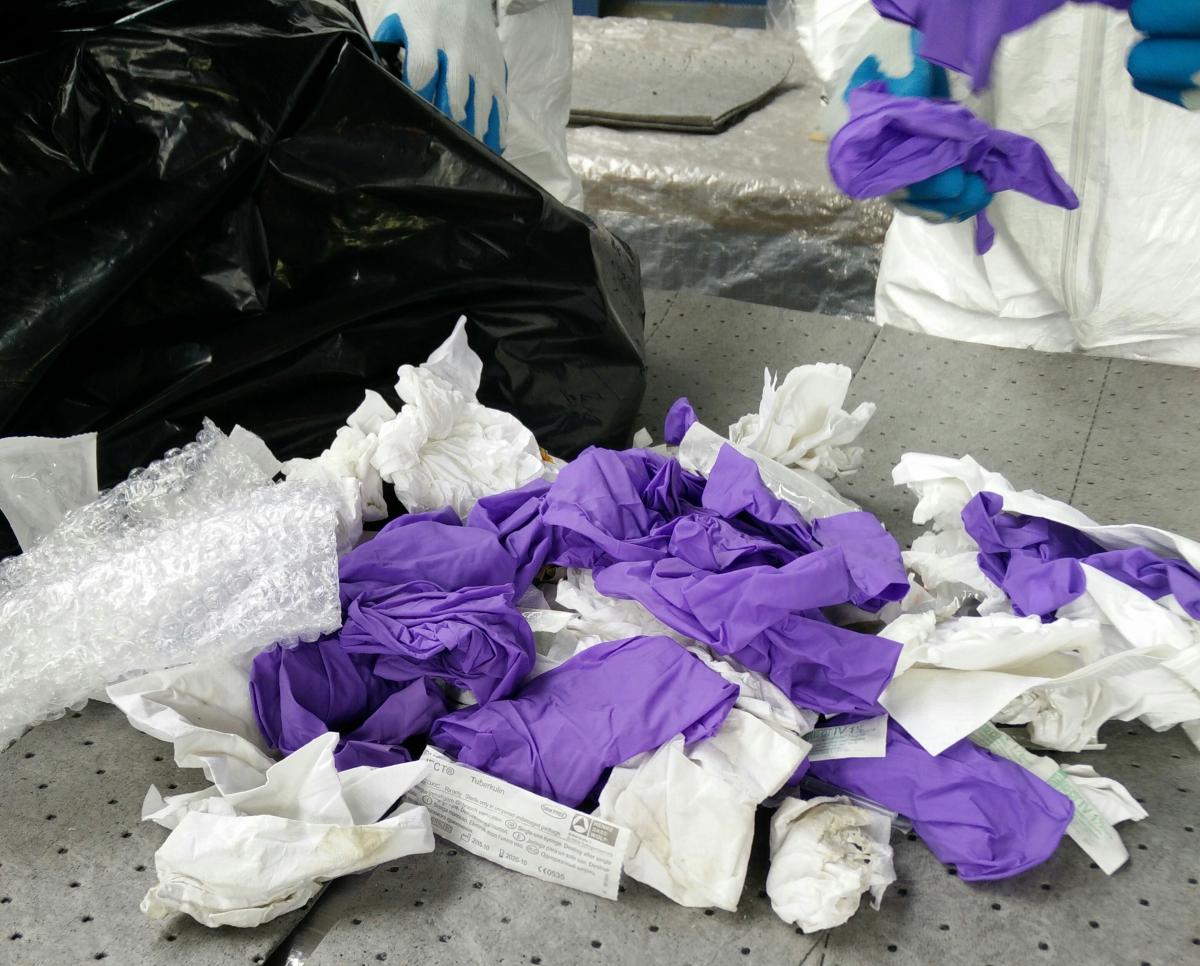
We are always attempting to reduce hazardous waste whenever possible, which includes solid wastes such as gloves, kim wipes, and plastic wastes that are generated in a laboratory. Generally, these items are not classified as hazardous waste, and can be disposed of as municipal waste.
CCIs that are considered hazardous waste are classified as such due to meeting one of the EPA’s Characteristic Waste definitions:
Ignitability: is the CCI saturated/contaminated such that it can meet the definition of being ignitable at a flash point less than 140 F, or has the potential to combust spontaneously or through friction?
Corrosivity: is the CCI saturated/contaminated such that the CCI waste pH’s less than 2 or greater than 12.5?
Reactivity: is the CCI saturated/contaminated to the point where it will react violently with water or is capable of detonation?
Toxicity: is the CCI saturated/contaminated to the point where a quantifiable amount could leach into the groundwater?
CCIs contaminated with anything acutely toxic (p-listed wastes in Appendix C of the Hazardous Waste Management Guide) are the most common CCIs that are collected for hazardous waste. If your lab generates this waste, is there a way to reduce or eliminate this waste stream altogether?
Near Miss Form
Have you had a close call, incident, or something else that did not cause damage or injury but may have? Something that could be a learning opportunity for others? Check out our "near miss form" on our website. Information submitted in the near miss forms will be used to forecast trends and update our annual safety training.
The Near Miss form can be found on our webpage.